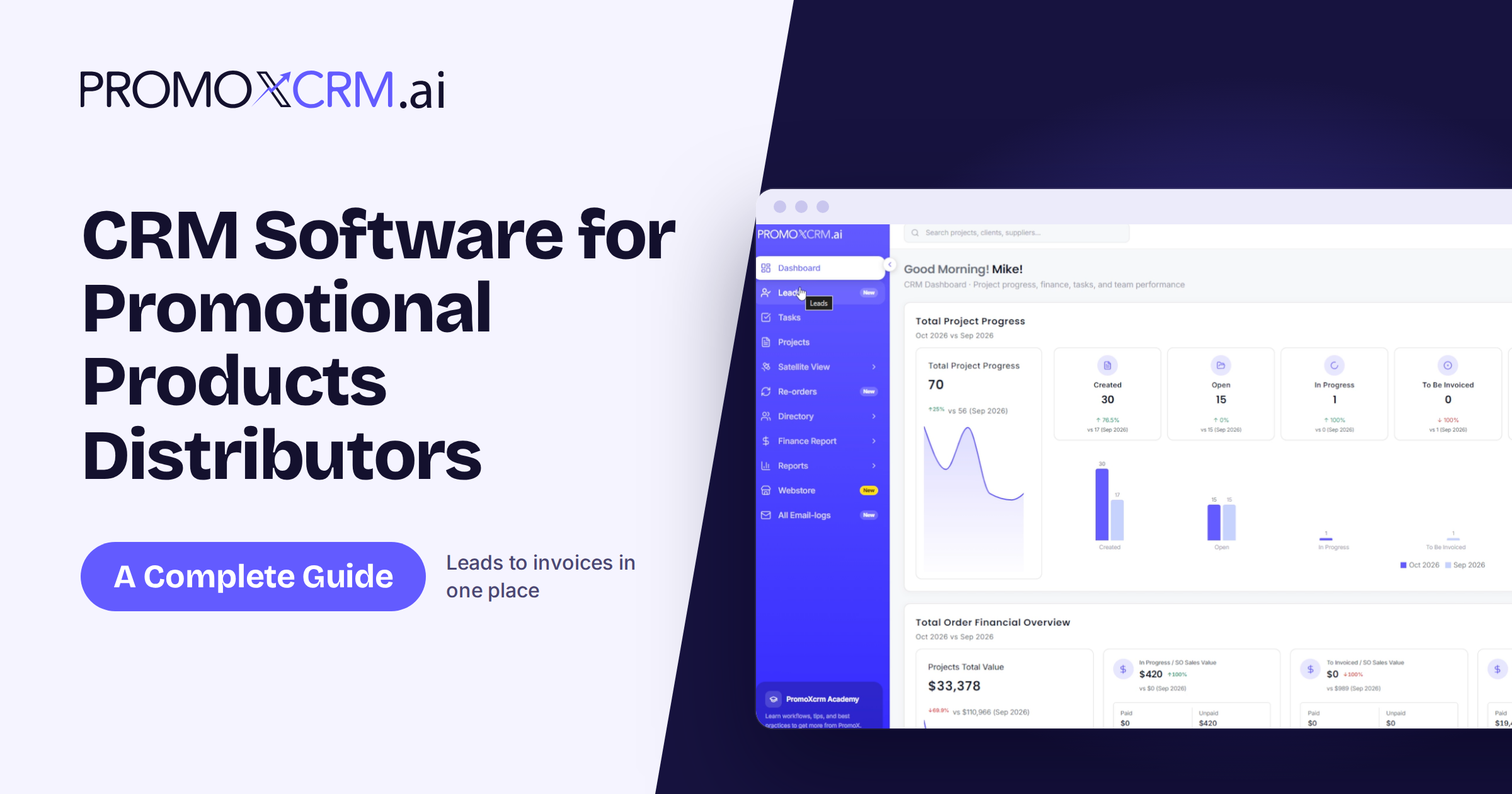
Choosing a CRM for a promotional products distributor means looking beyond a contact list. The real test is whether customer context stays useful as a conversation becomes a quote, an order and a future reorder.
Why promotional products businesses need a connected view
A promotional order is rarely just a sale. A customer may ask for ideas, compare products, approve a proof, revise quantities, wait for supplier confirmation and track delivery—all while the distributor manages several contacts and deadlines. If conversations live in one tool and order details in several spreadsheets, people spend time reconstructing context.
Put the idea into practice
A CRM for the promo industry should make the relationship useful throughout the order lifecycle. It helps teams see who the customer is, what has been discussed, what is active and which next step belongs to whom. It does not remove the need for good process design; it gives the process a shared place to live.
What to look for in promotional products CRM software
Start with the daily work. Can a salesperson capture an inquiry and follow-up? Can a team find customer preferences, prior orders and relevant contacts? Can accepted work move forward without retyping the same details? Can customer service and operations see current status? Those questions are more useful than a long feature checklist.
Put the idea into practice
A practical promotional software evaluation should also cover search, permissions, reporting, product information, onboarding and integrations. Ask vendors to distinguish native features from custom work or third-party connections. Confirm the exact accounting product edition, data direction, sync frequency and who handles errors before relying on an integration.
Map the workflow before comparing vendors
Choose one ordinary order and map it from first inquiry to invoice and reorder. At every stage write down the owner, required information, decision, deadline and handoff. Include common exceptions such as a proof revision, supplier substitution or a changed ship date. This exposes the points where people currently copy details or ask for updates.
Put the idea into practice
Then ask each provider to demonstrate that same scenario using realistic sample information. Note what is visible to sales, service and production, and what still requires a separate system. A CRM for promotional products companies should fit the way your team works, while making unclear steps easier to see.
Plan implementation around adoption
A rollout works better when teams agree on a small number of shared definitions: what qualifies as an active opportunity, when a quote is ready, who owns a customer update and what counts as an order milestone. Clean up duplicate contacts and outdated fields before importing records. Keep the first phase focused on a few workflows people use every day.
Put the idea into practice
Train with examples from your own business, give users a place to report friction and review adoption after launch. Ask in advance what data can be migrated, how attachments are handled, what onboarding includes and how changes are requested. Put the answers and responsibilities into the implementation scope.
A simple decision framework
Score each platform against fit, visibility, usability, integration clarity, migration, support and total cost. Give the people who will use the system a voice in the score. A feature that looks impressive in a presentation has little value if it adds extra steps to common work.
Put the idea into practice
For businesses comparing promotional products software for distributors, the strongest choice is the one that supports the required workflow and can be maintained by the team. Treat claims about results, compatibility and implementation timing as items to verify, not assumptions.
Conclusion
Choose a promotional products CRM by testing the work your team repeats most: customer follow-up, quote decisions, order handoffs and reorders. A clear demonstration and written scope will tell you more than a feature list alone.
Frequently asked questions
What is a promotional industry CRM?
It is customer relationship software evaluated or configured for promotional products workflows, where customer conversations connect to product selection, quotes, orders and follow-up.
Is a CRM enough to manage every order task?
That depends on the platform and your process. Confirm which sales, order and production steps are included, and where accounting, supplier or shipping tools remain involved.
How should a distributor compare CRM platforms?
Map a real order, demonstrate it with each provider, then compare usability, data migration, integrations, permissions, training and full costs in writing.